


 Pristupačnost
The Department of Sociology was established in 1992 and is one of the core disciplines of the Faculty of Croatian Studies. The concept of sociology studies focuses on the application of sociological theories and social science methodology for understanding social processes and phenomena in the specific context of Croatian society and comparatively in a European and global perspective. The study of sociology aims to train highly qualified sociological research personnel with professional research and analytical skills necessary for productive work in the public and private sectors. The sociology program at the bachelor's and master's levels is organized according to current international scientific standards.
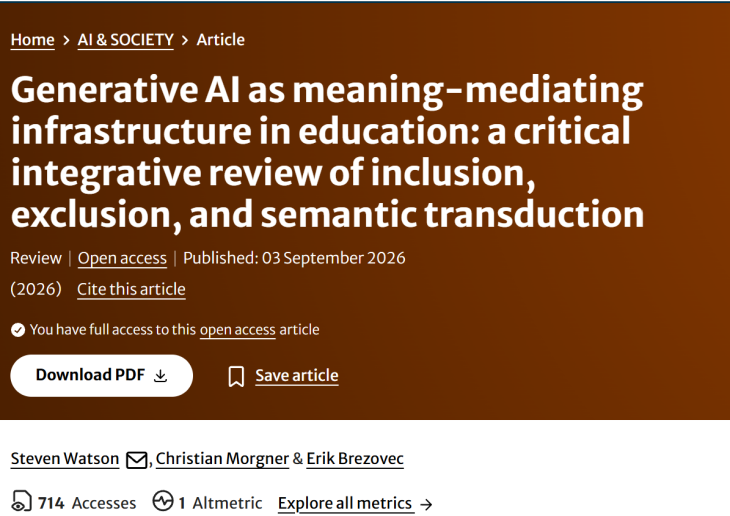
Assistant Professor Erik Brezovec, PhD, from the Department of Sociology at the Faculty of Croatian Studies, has published a new research paper entitled “Generative AI as meaning-mediating infrastructure in education: a critical integrative review of inclusion, exclusion, and semantic transduction.” The paper was published in early September in the international academic journal AI & Society, published by Springer Nature, and is available via open access.
The paper was co-authored with Steven Watson from the University of Cambridge and Christian Morgner from the University of Portsmouth.
The authors address the timely issue of the role of generative artificial intelligence in education, approaching AI not merely as a tool that facilitates students’ access to information. At the core of the paper is the question of how the use of generative AI changes the ways in which learners are recognized, supported, and evaluated within educational systems, and how it can contribute both to inclusion and to the emergence of new forms of inequality.
Particular attention is paid to differences in access to and capabilities for using AI, the possibility that AI may encourage standardized templates of “good” academic performance, and the changes its use brings to understandings of authorship, teaching, and assessment. The authors also introduce the concept of semantic transduction, which describes the way generative AI reformats educational demands—such as assignments, instructions, assessment criteria, and feedback—into communicatively plausible forms.
The authors conclude that individual AI literacy alone is insufficient to address potential educational inequalities. Broader responsibility on the part of educational institutions and other stakeholders is needed, including transparent rules for the use of AI, inclusive design, opportunities to contest decisions, and continuous monitoring of AI’s effects on education.
The paper is available via open access on the Springer Nature website.