


 Pristupačnost
The Department of Sociology was established in 1992 and is one of the core disciplines of the Faculty of Croatian Studies. The concept of sociology studies focuses on the application of sociological theories and social science methodology for understanding social processes and phenomena in the specific context of Croatian society and comparatively in a European and global perspective. The study of sociology aims to train highly qualified sociological research personnel with professional research and analytical skills necessary for productive work in the public and private sectors. The sociology program at the bachelor's and master's levels is organized according to current international scientific standards.
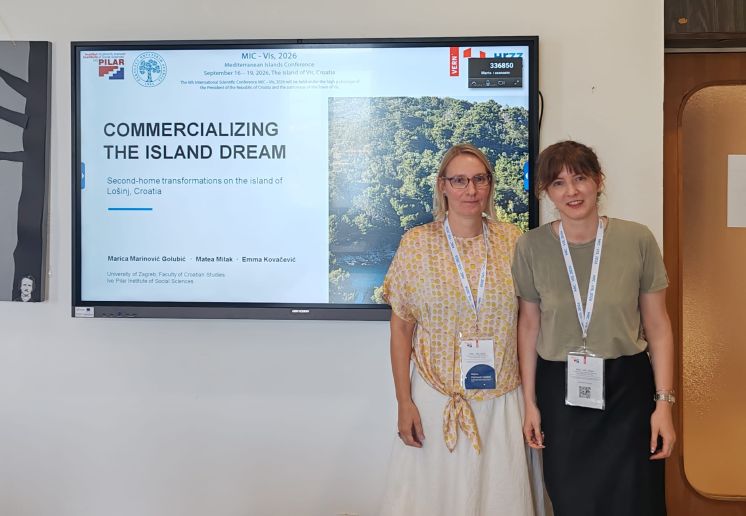
Faculty members of the Department of Sociology at the University of Zagreb Faculty of Croatian Studies, Associate Professor Marica Marinović Golubić and Assistant Professor Ivan Perkov, participated in the 6th International Multidisciplinary Scientific Conference MIC – Vis 2026, held from 16 to 19 September on the island of Vis. The international scientific conference brought together more than 250 researchers, experts, and professionals from Croatia and abroad with the aim of fostering interdisciplinary discussion of the social, cultural, economic, and environmental challenges facing the Mediterranean and its islands.
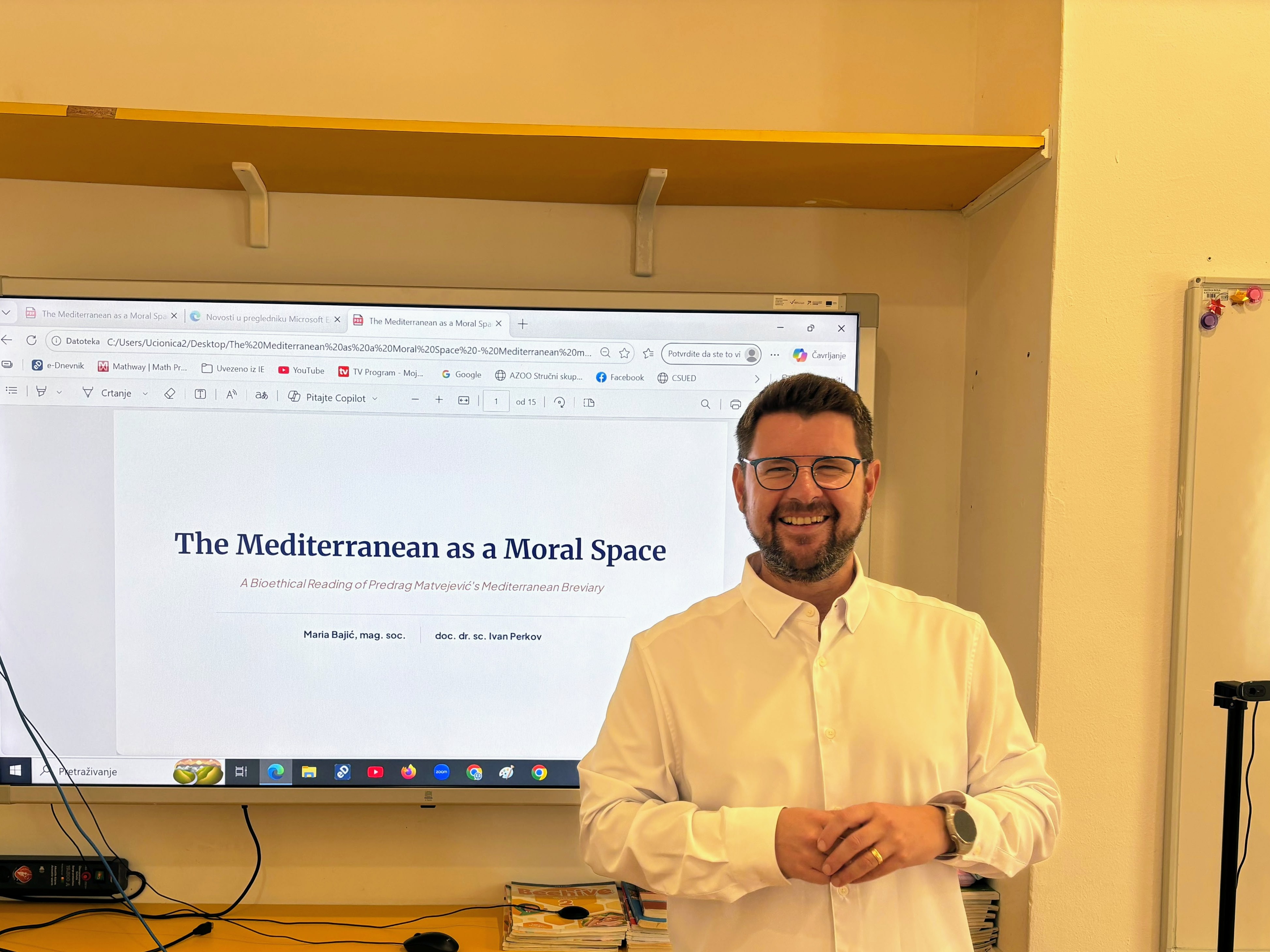
Within the section dedicated to art, literature, culture, and tradition, Assistant Professor Ivan Perkov and Maria Levačić presented the paper The Mediterranean as a Moral Space: Implicit Bioethics in the Work of Predrag Matvejević. The paper offers a sociological and bioethical reading of Predrag Matvejević’s Mediterranean: A Cultural Landscape, one of the most widely translated Croatian books and a prominent work of contemporary Mediterranean thought.
The presentation centered on the question of whether space, beyond its geographical, historical, and cultural dimensions, can also carry moral meaning. Matvejević’s Mediterranean is viewed as a multilayered space in which different languages, religions, cultures, and communities meet, shaped by centuries of trade, migration, conflict, and mutual influence. Particular emphasis was placed on bioethical responsibility towards space, the environment, and the community. In Matvejević’s work, the sea, coast, stone, olive trees, and grapevines are not merely features of the Mediterranean landscape but also bearers of cultural memory and ways of life. Responsibility towards the Mediterranean therefore involves preserving not only its ecosystems but also its languages, memories, cultural diversity, and capacity for coexistence.
 At the same conference, Associate Professor Marica Marinović Golubić presented the paper Commercializing the Island Dream: Second-home Transformations on the Island of Lošinj, Croatia, co-authored with Matea Milak, PhD, and Emma Kovačević, PhD, from the Institute of Social Sciences Ivo Pilar.
The presentation introduced the results of qualitative research conducted among permanent and temporary residents of the island of Lošinj. The research was carried out in April and June 2026 and involved 18 participants. Lošinj was selected as a particularly relevant case due to its long tourism tradition, spanning approximately 140 years, as well as its pronounced “housing paradox”: between 2001 and 2021, the population decreased by approximately 10%, while the number of dwellings increased by approximately 17%.
The research focused on changes in patterns of second-home ownership and use, as well as on how contemporary owners perceive the value of their second homes – primarily as a source of income or as private spaces associated with family leisure, belonging, and continuity. The findings indicate that these two functions are often not mutually exclusive. A second home can simultaneously serve as a family space and an economic resource, for example, when owners use one part of the house while renting out another, or use the property themselves for part of the year and rent it out during the peak tourist season. Rental income can also support the renovation and maintenance of the family home, meaning that commercialisation does not necessarily displace its private and family functions.
The presentation was developed within the Croatian Science Foundation project Transformation of Second Home Use in the Age of Online Social Networking (HomesNetting; IP-2022-10-8104).
The conference provided an opportunity to exchange research experiences and establish connections with scholars from different disciplinary backgrounds who study contemporary processes in the Mediterranean.