

 Pristupačnost
The Department of Sociology was established in 1992 and is one of the core disciplines of the Faculty of Croatian Studies. The concept of sociology studies focuses on the application of sociological theories and social science methodology for understanding social processes and phenomena in the specific context of Croatian society and comparatively in a European and global perspective. The study of sociology aims to train highly qualified sociological research personnel with professional research and analytical skills necessary for productive work in the public and private sectors. The sociology program at the bachelor's and master's levels is organized according to current international scientific standards.
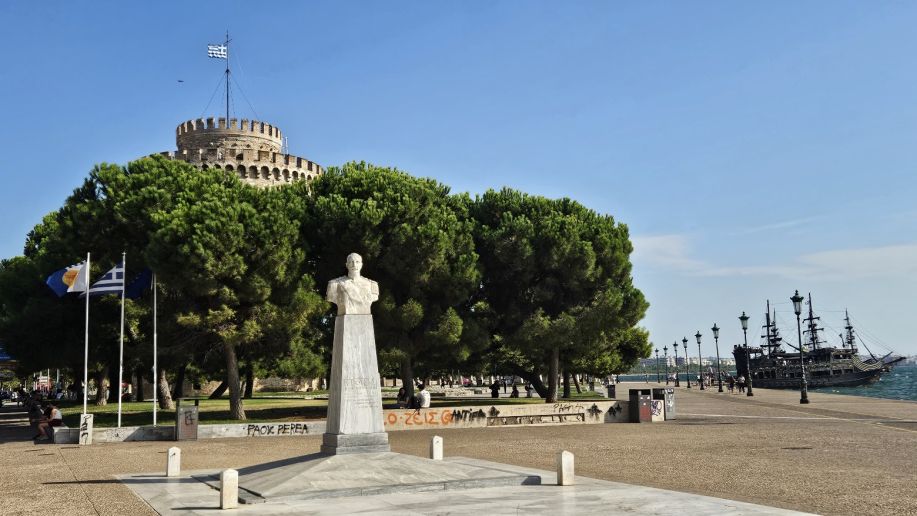
Photo: Ivan Perkov
Assistant Professor Ivan Perkov of the Department of Sociology at the Faculty of Croatian Studies participated late last month in the international seminar “Teaching about the Holocaust”, organised for educators from Croatia and Slovenia by Yad Vashem’s International School for Holocaust Studies. The seminar was held in Thessaloniki, a city whose rich Jewish history provided a particularly significant context for discussions on Holocaust education, the culture of remembrance, and contemporary educational challenges.
The multi-day programme combined expert lectures, workshops, fieldwork, and meetings with representatives of the Jewish community. Participants were introduced to Yad Vashem’s educational approach, methods of incorporating survivor testimonies into teaching, and approaches to teaching about the “Final Solution”, the Holocaust in Greece, and the Righteous Among the Nations. A special part of the programme included visits to synagogues and the Jewish Museum of Thessaloniki, as well as a meeting with David Saltiel, President of the Jewish Community of Thessaloniki. The programme also included a lecture by Dr. David Silberklang on the implementation of the “Final Solution,” visits to the Baron Hirsch area and the former railway station from which Thessaloniki’s Jews were deported, the site of the former Jewish cemetery on the grounds of today’s Aristotle University, and the Holocaust Memorial. Workshops focusing on personal testimonies, victims’ final letters, and survivors’ experiences further highlighted the importance of an approach that restores to victims their names, biographies, and individual human experiences.
Participation in the seminar was particularly valuable in the context of the further development of the Holocaust course at the Faculty of Croatian Studies, taught by Professor Renato Matić and Assistant Professor Ivan Perkov. The exchange of experiences with colleagues and Yad Vashem experts opened up a range of new opportunities for enhancing teaching, developing international cooperation, organising educational programmes and exhibitions, and involving students in additional forms of learning about the Holocaust and the culture of remembrance.
The stay in Thessaloniki also created opportunities for more concrete future cooperation between the Faculty of Croatian Studies and Yad Vashem. Discussions addressed the possibility of organizing educational programs and exhibitions in Zagreb, hosting guest experts, and developing various forms of cooperation within the course and future projects. The seminar, therefore, represented not only valuable professional development but also an important step towards strengthening the international connections of the Department of Sociology in the field of Holocaust studies and education.
Participation in the seminar also reaffirmed the importance of integrating sociological perspectives, historical knowledge, and contemporary educational methods in working with students, particularly when addressing issues of violence, responsibility, antisemitism, social institutions, and the culture of remembrance.
