


 Pristupačnost
The Department of Sociology was established in 1992 and is one of the core disciplines of the Faculty of Croatian Studies. The concept of sociology studies focuses on the application of sociological theories and social science methodology for understanding social processes and phenomena in the specific context of Croatian society and comparatively in a European and global perspective. The study of sociology aims to train highly qualified sociological research personnel with professional research and analytical skills necessary for productive work in the public and private sectors. The sociology program at the bachelor's and master's levels is organized according to current international scientific standards.
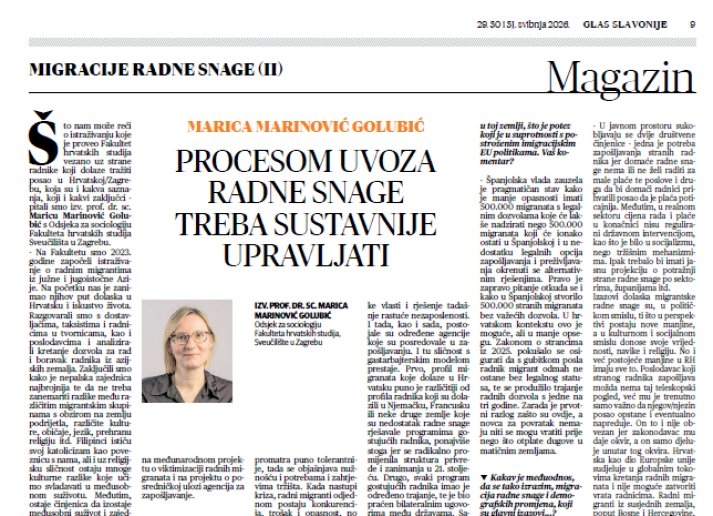
Photo: Glas Slavonije
Associate Professor Marica Marinović Golubić, PhD, from the Department of Sociology at the Faculty of Croatian Studies, University of Zagreb, gave a statement for a feature article published in Glas Slavonije Magazine on 29 May, dedicated to foreign workers from South and Southeast Asia in Croatia. The article explores the broader social and economic context of contemporary labour migration and the changes it brings to the Croatian labour market.
Particular emphasis is placed on the fact that the current model of labour migration differs significantly from the traditional gastarbeiter model, primarily due to the increased role of labour markets and recruitment agencies, as well as more complex migration procedures, which often represent a considerable financial burden for migrant workers themselves.
In discussing current migration policies, the article highlights the importance of an appropriate legislative framework and the need for systematic management of migration processes. Recent legal amendments have provided a more stable status for labour migrants, for example, through the extension of work permit validity periods. However, the issue of long-term migration planning and governance remains unresolved.
The article also points out that the process of importing foreign labour is difficult to reverse and that Croatia’s key challenge will be the development of transparent and sustainable policies that take into account both economic needs and the social consequences of migration flows.
The full article is available in Croatian at the following link: The Process of Importing Foreign Labour Requires More Systematic Management.