


 Pristupačnost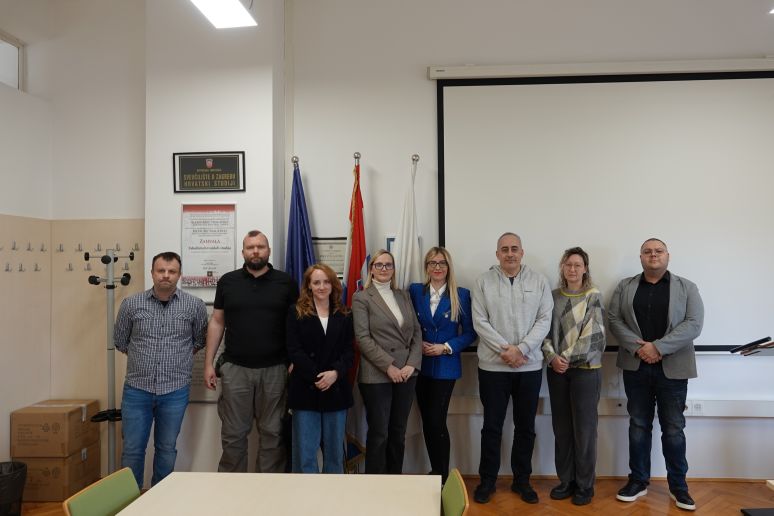
The first meeting of the scientific research project "Artificial Intelligence: The New Interlocutor of Croatian Society (AI-COM)" was held at the Faculty of Croatian Studies on 1 April 2026. The project is financed from the National Recovery and Resilience Plan (NRRP) with the support of the European Union - Next Generation EU. The project leader is Assoc. Prof. Dr. Sc. Marko Kardum, Head of the Department of Philosophy and Culturology at the Faculty of Croatian Studies.
The project involves experts in philosophy, communication studies, sociology and psychology: Assoc. Prof. Dr. Sc. Ivana Greguric, Assoc. Prof. Dr. Sc. Sandro Skansi, Assoc. Prof. Dr. Sc. Ivan Burić, Assoc. Prof. Dr. Sc. Željka Metesi Deronjić, Assoc. Prof. Dr. Sc. Vanesa Varga and Assoc. Prof. Dr. Sc. Ana Marija Dunaj. External project collaborators are: Prof. Dr. Sc. Marina Merkaš, Assoc. Prof. Dr. Sc. Stefan Lorenz Sorgner and Dr. Sc. Kristina Šekrst.
The first meeting was attended by Assoc. Prof. Dr. Sc. Vlatko Smiljanić, Vice-Dean for Business Affairs at the Faculty of Croatian Studies, and Tea Cacović, Head of the Science and Projects Service at the Faculty of Croatian Studies. During the meeting, the key steps of the project implementation were defined. The project will be implemented over four years, and brings together an interdisciplinary team of scientists with the aim of researching the role and impact of artificial intelligence in contemporary Croatian society. This interdisciplinary approach will enable a comprehensive view of artificial intelligence as a technological, but also a social phenomenon.
The project plans to develop an integrated philosophical-pragmatic framework for the analysis of contemporary artificial intelligence that connects the historical development of cybernetics, connectionist models and transformer-based language models with issues of language, meaning and understanding. It is also expected that the results of empirical research will contribute to a better understanding of the way in which artificial intelligence affects everyday life, communication and decision-making. Special emphasis is placed on the development of ethical guidelines and recommendations for the responsible use of artificial intelligence in society.