

 Pristupačnost
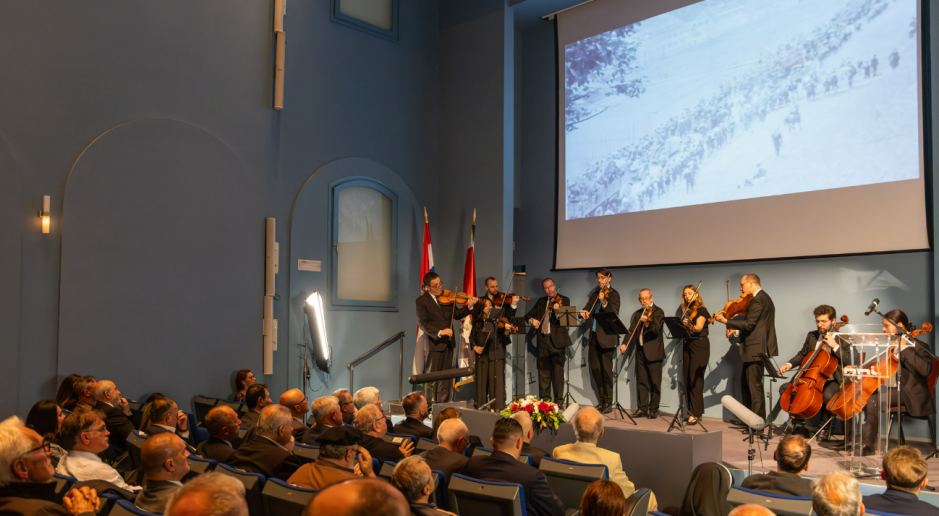
A commemorative academy marking the 80th anniversary of the Bleiburg Tragedy and the Way of the Cross of the Croatian people was held on Thursday, 15 May, at the Vijenac Hall of the Archdiocesan Pastoral Institute in Zagreb, organized by the Bleiburg Honour Guard. This year's commemoration placed particular emphasis on the contribution of scholarly research to preserving historical truth, a field in which the Institute of Scientific Research of the Faculty of Croatian Studies at the University of Zagreb plays an important role.
As part of the programme, the proceedings of the International Professional and Scholarly Symposium entitled “The Culture of Remembrance of the Wartime and Post-war Victims of the Bleiburg Tragedy and the Way of the Cross of the Croatian People” were presented. The volume was published by the Department of History, the Institute of Scientific Research of the Faculty of Croatian Studies, and the Bleiburg Honour Guard. It was presented by its editors, Associate Professor Wollfy Krašić, PhD, Ivan Tepeš, PhD, and Academician Stjepan Ćosić. The programme was moderated by Associate Professor Vlatka Vukelić, PhD.
One of the volume's editors, Associate Professor Wollfy Krašić, PhD, is also the author of the paper entitled “The Most Prominent Commemorations of the Bleiburg Tragedy in Croatian Diaspora Communities and at the Bleiburg Field between 1945 and 1990,” published in the collection.
“In my paper, I point out that the Bleiburg Tragedy constituted an important part of both the collective and individual identities of Croatian political émigrés, as reflected in their organization of public commemorations. Over time, commemorations honouring the victims of the Bleiburg Tragedy came to express an increasingly strong sense of Croatian unity. Consequently, the event came to be recognized as a Croatian national tragedy rather than the defeat of a particular political faction. As regards the messages conveyed at these commemorations concerning the future, they did not call for revenge or similar actions, but rather for continued perseverance in the struggle for an independent Croatian state. This was regarded as the only effective safeguard against the occurrence of ‘new Bleiburgs’, as well as the greatest, most fitting, and most enduring memorial to the victims of the Bleiburg Tragedy,” Krašić stated.
The event's moderator, Associate Professor Vlatka Vukelić, PhD, noted that “communist crimes, such as those committed at Bleiburg and during the Way of the Cross, remained a taboo subject in the former Yugoslavia for a long time. The memory of these events survived primarily at the private level, without public commemorations. It was only following the dissolution of Yugoslavia and Croatia's attainment of independence that public debate on the victims of communism became possible. Bleiburg became a symbol of communist repression and a symbolic site of collective remembrance for the Croatian people.” She further noted that, through various resolutions, the European Parliament and the Council of Europe had condemned all totalitarian regimes of the twentieth century, both Nazi and communist, emphasizing the need to preserve historical memory and ensure justice for the victims. These documents call for a clear dissociation from communist crimes and their unequivocal condemnation.
Nevertheless, public awareness of communist crimes in Croatia and Europe remains limited, while communist symbols continue to be present in public spaces. The first official state commemoration at Bleiburg was held only in 1995, and the Croatian Parliament designated 15 May as the Day of Remembrance for Croatian Victims. In this way, Bleiburg acquired official status as a site of remembrance of significance to Croatian national identity.
Academician Stjepan Ćosić emphasized that the volume on the Bleiburg Tragedy brings together a historiographical approach and the culture of remembrance, highlighting the importance of an open, non-dogmatic, and humanizing approach to historical writing that fosters dialogue and understanding. He stressed that the Croatian people, like many other European nations, continue to grapple with the difficult legacy of the twentieth century, and that historiography has an important role to play in raising awareness and safeguarding identity through a well-substantiated analysis of the past.
Ivan Tepeš, PhD, pointed out that the collection comprises 14 papers covering the period from 1944 to the present day. The contributions are based on extensive documentation from several countries and include previously unknown information. He emphasized that the volume focuses on the culture of remembrance and commemorations of the Bleiburg Tragedy and the Way of the Cross, expressing the hope that it would attract the interest not only of the scholarly community but also of the general public and political stakeholders, thereby helping to prevent the recurrence of ideological narratives from the past.
The programme was enriched by musical performances by the Zagreb Soloists, baritones Ljubomir Puškarić and Jan Vukelić, mezzo-soprano Martina Gojčeta Silić, and actors Luca Anić and Joško Ševo.